Behind the Artefact: Maori Design Language
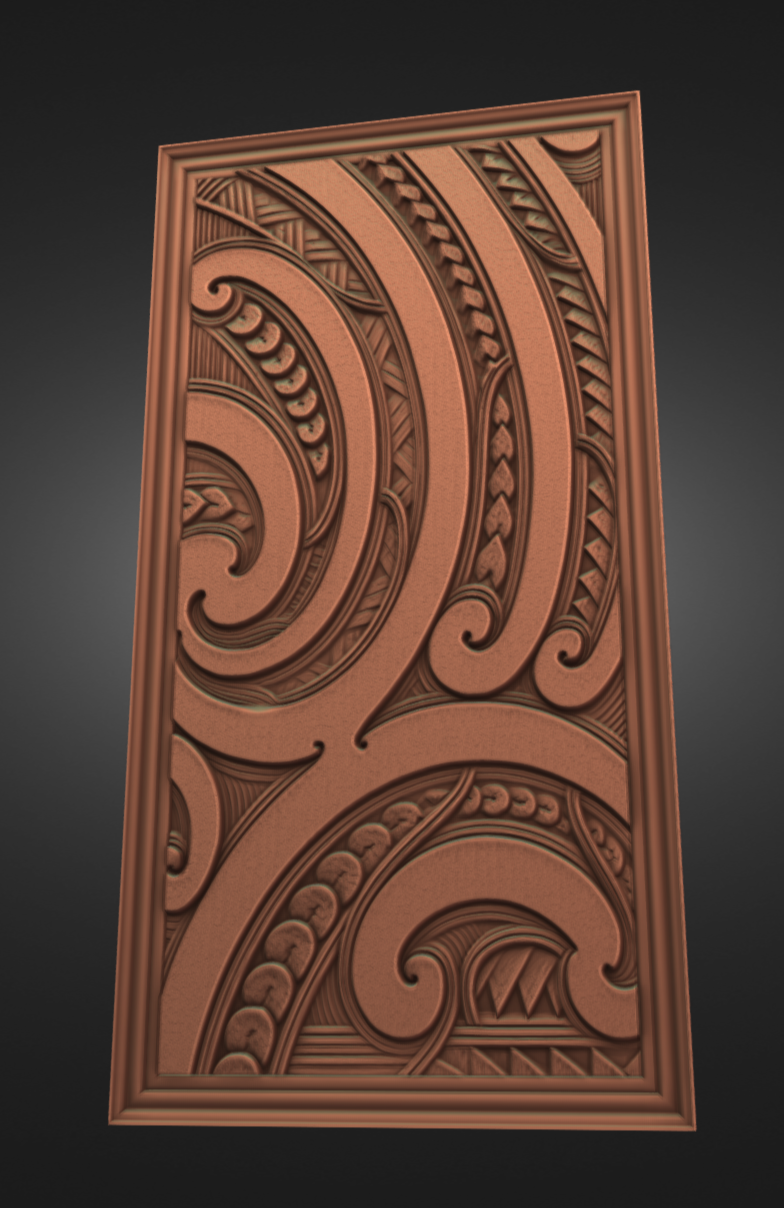
Tap a glowing point on the bookmark
to learn about each design element
Matariki Series — Kōrero o te Ao
The Object
This is a bookmark. It is printed in wood-composite PLA filament, finished with linseed oil, and has an NFC sticker on the back. Tap the sticker with your phone and it opens this page.
It was made during Matariki 2026 — the Māori New Year, observed when the Matariki star cluster rises on the horizon before dawn in late June or early July. Matariki is a time for remembering the dead, celebrating the present, and setting intentions for the year ahead. Making something that teaches felt like the right thing to do with that window.
The design on the front is not decorative. Every element has a name, a meaning, and a documented source. That is the point of this piece.
Matariki and the Nine Stars
Matariki is not a single star. It is a cluster — the Pleiades — and in te ao Māori (the Māori world), nine individual stars within it are named and each governs a specific domain of life.
Matariki herself oversees health, wellbeing, and the natural environment. Pōhutukawa is the star of the dead — those who have passed since the last rising are carried to her. Hiwa-i-te-rangi is the wishing star, the one you speak your aspirations to. Waitī and Waitā govern freshwater and saltwater respectively. Tupuānuku and Tupuārangi govern food from the ground and food from above. Waipuna-ā-Rangi governs rain. Ururangi governs the winds.
The Matariki Series is a set of bookmarks — one for each star. This is the first. The others will follow.
The Design Language
The patterns on this bookmark are drawn from a documented Māori design framework developed by Dr. Johnson Witehira in his 2013 PhD thesis at Massey University, Toi Rangatira: A Māori Design Language. The thesis analyses carved pare (door lintels) from wharenui (meeting houses) to identify the underlying grammar of Māori visual design — the named elements, the structural principles, and the rules that govern how they work together.
This is not a generic "Māori-inspired" design. The elements used have specific names and specific meanings. The hotspot widget above identifies each one.
The four structural principles from Witehira's framework that govern this composition:
Tātai hangarite — bilateral symmetry as the structural base. The mirrored koru pair at top and bottom anchor the vertical axis.
Tātai hikuwaru — deliberate disruption of that symmetry to create vitality. A composition that is perfectly symmetrical is static. The asymmetric break in the manaia's body is intentional.
Tātai manawa — a continuous implied flow that guides the eye through the composition without interruption. Entry at the top koru, through the manaia centre, resolution at the lower koru.
Tātai rahinga — hierarchy by scale. The manaia at the centre is the largest element because it is the primary symbolic one.
The Build
Printed in wood-composite PLA filament — a standard PLA base with fine wood particles suspended in it. The wood content is low enough that it prints reliably on a standard FDM printer, but high enough that the surface responds to oil finishing the way real timber does.
The relief depth on the carved elements is the critical variable. Too shallow and the pattern reads as flat texture. Too deep and fine details like the rauponga fill collapse into the base layer. The version you are holding has been calibrated to sit in the middle of that range.
After printing, the surface was finished with linseed oil. The oil darkens the recesses and brings out the grain in the raised areas, making the pattern significantly more legible than the raw print. It also seals the surface.
The hole at the top is sized for a standard 4mm cord or tassel.
Attribution
The design language used in this piece is documented in:
Witehira, J.G.P. (2013). Toi Rangatira: A Māori Design Language. PhD Thesis, Massey University, Palmerston North, Aotearoa New Zealand. Available via Massey Research Online.
Dr. Witehira spent years documenting a visual language that most people walk past without recognising. This bookmark exists because of that work. A copy of this piece has been sent to him.
Arcanium Studios does not claim ownership of the design language. We are using it, sourcing it, and pointing people back to the person who documented it.
Why It Matters
Most objects that use indigenous design patterns do not explain them. They borrow the aesthetic and discard the meaning. The result is decoration that looks like it carries significance but does not.
This bookmark is an attempt to do the opposite. The NFC sticker on the back exists specifically so that the object can carry its own context. You do not need to already know what rauponga means, or why the manaia faces the way it does, or what tātai manawa is. The object tells you, if you tap it.
The Matariki Series will eventually cover all nine stars, each with its own design, its own dominant motif, and its own page. This is the first one.
Made in Sydney, July 2026. Arcanium Studios.
RAUPONGA
The Surface Fill
Rauponga is the most widely used surface-fill pattern in Māori carving. It consists of alternating rows of two simpler elements: haehae (parallel grooves cut into the surface) and pākati (dog-tooth triangles, also called niho taniwha — the teeth of the taniwha). The two patterns repeat in bands across the carved field, creating a dense, rhythmic texture that fills the space between the primary motifs.
The name rauponga refers to the layered, repetitive nature of the pattern — rau meaning leaf or layer, ponga referencing the silver fern. It is the background that makes the foreground legible. Without rauponga fill, a carved composition would have large empty areas that draw the eye away from the primary motifs. With it, the entire surface becomes active.
In wood filament printing, rauponga is one of the most printable Māori patterns at small scale. The alternating relief depth — raised triangles against recessed grooves — creates shadow contrast that reads clearly even at bookmark dimensions. The oil finish darkens the recesses and makes the tooth pattern significantly more visible than the raw print.
Design principle: Tātai manawa — the continuous pulse. Rauponga maintains visual rhythm across the surface so that no area becomes visually dead. It is the connective tissue of the composition.
Matariki connection: This bookmark is dedicated to Matariki herself — the central star, governing health, wellbeing, and the natural environment. Rauponga's layered, repeating structure reflects the cyclical rhythms of the natural world that Matariki presides over.
Source: Witehira, J.G.P. (2013). Toi Rangatira: A Māori Design Language. PhD Thesis, Massey University. Chapter 5: Surface fill patterns — rauponga, pp. 118–122.
KORU COLUMN
The Continuous Spiral
The koru is the foundational curvilinear element of Māori design. It is derived from the new shoot of the ponga (silver fern) — the tightly coiled frond that unfurls as the plant grows. In Māori visual language, the koru represents new beginnings, growth, and the nurturing of life. It is the most immediately recognisable Māori motif and one of the few that has entered broad international awareness.
In the koru column bookmark, four koru spirals are arranged in a vertical sequence, each one flowing into the next. This is the design principle of tātai manawa made visible — the continuous pulse that moves through the composition from entry to exit without interruption. The eye enters at the top spiral, follows the implied flow downward, and resolves at the base. Nothing stops it.
The alternating orientation of the spirals — each one curling in the opposite direction to the one above — creates the tātai hikuwaru disruption that Witehira identifies as essential to a living composition. A column of identical spirals would be static. The alternation gives it movement.
Design principle: Tātai manawa (continuous flow) combined with tātai hikuwaru (deliberate disruption through alternating orientation).
Matariki connection: This bookmark is dedicated to Hiwa-i-te-rangi — the wishing star, the star of aspirations and goal-setting. The koru's meaning of new beginnings and growth maps directly onto Hiwa-i-te-rangi's domain. Matariki tradition holds that you speak your intentions to this star during the rising. The koru column is a physical record of that act.
Source: Witehira, J.G.P. (2013). Toi Rangatira: A Māori Design Language. PhD Thesis, Massey University. Chapter 4: Koru as primary curvilinear motif, pp. 89–94.
MANAIA — URURANGI
The Guardian in the Wind
The manaia is a profile figure that combines three creatures in one form: the beak of a bird, the body of a human, and the tail of a fish. It is a spiritual guardian — a messenger that moves between the physical world and the spiritual one, between the living and the dead. In carved compositions, the manaia often appears at the edges or flanking a central figure, watching outward, guarding the threshold.
In this bookmark, the manaia's serpentine body coils the full length of the piece, its bird-beak facing upward and its tail resolving at the base. A second, smaller manaia appears at the lower section — the deliberate asymmetric disruption (tātai hikuwaru) that gives the composition vitality. The rauponga fill covers the body, marking it as a figure of substance rather than outline.
The manaia's spiral eye is one of the most distinctive elements in Māori carving. It is not decorative — it signifies awareness, the capacity to see across the boundary between worlds. A manaia without a spiral eye is incomplete.
Design principle: Tātai rahinga — hierarchy by scale. The large manaia dominates the composition because it is the primary symbolic element. The smaller one at the base creates depth and movement without competing.
Matariki connection: This bookmark is dedicated to Ururangi — the star of winds. The manaia is the messenger, the one who moves between realms. Wind is the medium of that movement. Ururangi governs the winds of the new year; the manaia rides them.
Source: Witehira, J.G.P. (2013). Toi Rangatira: A Māori Design Language. PhD Thesis, Massey University. Chapter 4: Manaia as guardian motif, pp. 101–107.
PĀTIKITIKI — TUKUTUKU
The Woven Wall
Pātikitiki is a pattern from the tukutuku tradition — the latticework panels woven from kiekie reed, muka (flax fibre), and tōtara wood strips that line the interior walls of wharenui (Māori meeting houses). The pattern consists of interlocking diagonal diamonds, created by the over-under weaving of horizontal and vertical elements. At fine scale it reads as a mesh or lattice; at larger scale the diamond shapes become distinct.
Tukutuku is significant for a reason that goes beyond the visual. In the wharenui, the carved pare (door lintel) and the carved poupou (wall posts) are the domain of men — tāne. The tukutuku panels that fill the spaces between the carved posts are the domain of women — wāhine. The two traditions are not ranked. They are complementary. The carving and the weaving are two halves of the same wall. You cannot be inside a wharenui without being surrounded by both.
This is not a historical footnote. It is a structural feature of the design tradition — a built-in acknowledgement that different forms of knowledge and labour are held in parallel, not in hierarchy. The pātikitiki bookmark carries that context with it.
Design principle: Tātai hangarite — the bilateral symmetry of the woven grid. Every intersection is governed by the same rule. The pattern is democratic in a way that carved motifs are not.
Matariki connection: This bookmark is dedicated to Waitī — the star of freshwater environments, rivers, and lakes. Tukutuku panels are woven with materials drawn from freshwater margins: kiekie grows along stream banks, flax thrives in wetlands. The weaving tradition and the water domain share the same source.
Source: Witehira, J.G.P. (2013). Toi Rangatira: A Māori Design Language. PhD Thesis, Massey University. Chapter 5: Tukutuku and woven pattern traditions, pp. 130–135.
Note on tukutuku gender roles: This is a well-documented aspect of Māori material culture. For further reading see: Te Ara — The Encyclopedia of New Zealand, "Weaving — raranga and whatu," and Mead, H.M. (2003). Tikanga Māori: Living by Māori Values. Huia Publishers.