References
[1] Museo Nacional de Antropología. Mexica Hall — The Sun Stone. INAH, Mexico City.
[2] Google Arts & Culture × MNA. "Decoding the Sun Stone."
[4] Wikipedia. "Aztec sun stone."
[5] Our Life with Props. "Pirates of the Caribbean Cortés Gold," 20 July 2016.
Some objects carry more history than they appear to.
A coin is one of the most ordinary things a person can hold. It passes through thousands of hands. It represents value, exchange, time. Most coins are forgotten the moment they leave your pocket.
This one was designed to be remembered.
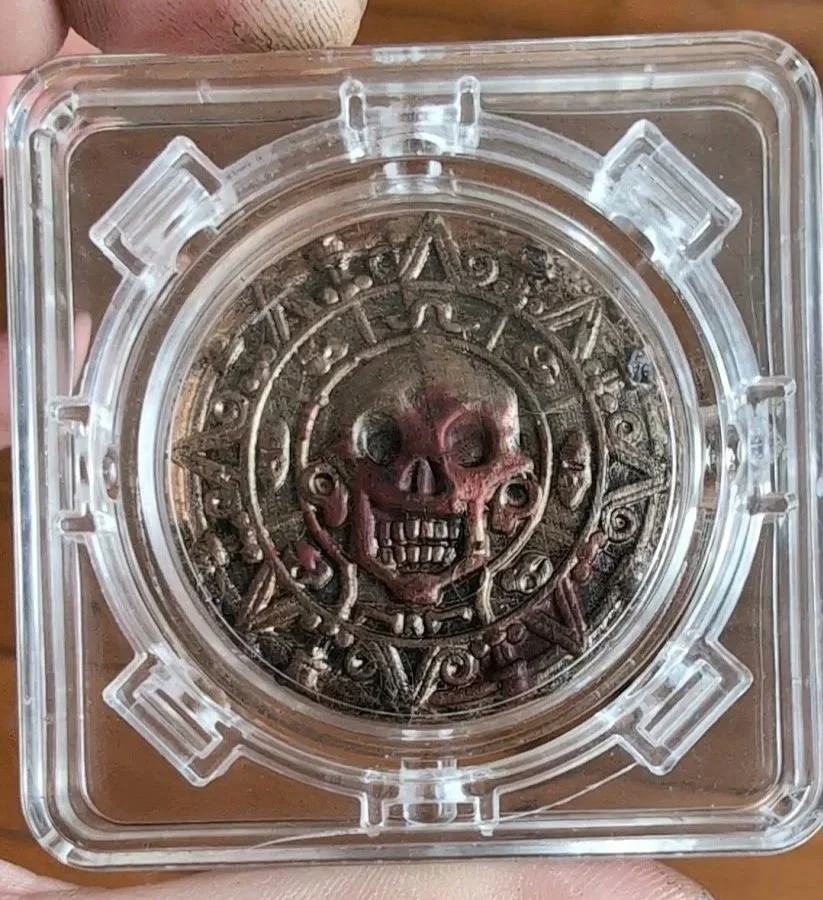
The Arcanium Aztec Medallion is a handmade resin piece cast and finished to replicate the cursed gold coin from Pirates of the Caribbean: The Curse of the Black Pearl. One face carries the skull design from the film. The other carries the concentric ring structure of the Mexica Sun Stone — the Piedra del Sol — one of the most significant archaeological objects in the Americas.
Embedded in the coin is an NTAG 213 NFC chip. Tap it with your phone and it opens an interactive exhibition. The coin is the key.
But before we get to the build, it is worth understanding what the coin is actually referencing — and why the connection between a 2003 blockbuster and a fifteenth-century Mexica monolith is more considered than it might first appear.
The Piedra del Sol
The Sun Stone is a basalt monolith carved by the Mexica people between 1502 and 1520 CE, during the reign of Motecuhzoma II. It measures 3.6 metres in diameter and weighs approximately 24 tonnes.
It was buried face-down after the Spanish conquest of Tenochtitlan and remained underground for nearly 270 years. In 1790, workers excavating Mexico City's Plaza Mayor — built directly over the ruins of the Aztec capital — unearthed it. It has been a centrepiece of Mexican national identity ever since, reproduced on coins, stamps, and public monuments.
Despite its popular name, it is not a functioning calendar. It is a monumental cosmological sculpture — a representation of Mexica beliefs about time, creation, and the cyclical destruction and renewal of worlds. The stone encodes the Mexica understanding of five cosmic eras, or "suns," each ending in catastrophe before the next began.
The centre of the stone depicts a face holding a human heart in clawed hands, with a sacrificial knife (tecpatl ) for a tongue. The Museo Nacional de Antropología notes that the lower half of the face is fleshless and the upper half normal — a single image encoding both life and death simultaneously. The figure's identity remains debated among scholars: it is widely attributed to Tonatiuh, the solar deity, but some argue it represents the earth monster Tlaltecuhtli.
The first ring surrounding the centre contains twenty distinct glyphs representing the days of the Mexica month — among them Cipactli (crocodile), Miquiztli (death), and Xōchitl (flower). Each carries specific cosmological meaning. The outer border is dominated by two massive fire serpents (Xiuhcoatl), their bodies meeting face-to-face at the base. The MNA describes their precise symbolism as "unknown."
The stone is currently the centrepiece of the Mexica Hall at the Museo Nacional de Antropología in Mexico City, where it has been on permanent display since 1964.
The Film Coin
In Pirates of the Caribbean: The Curse of the Black Pearl (2003), the coin is one of 882 identical pieces of Aztec gold delivered to the conquistador Hernán Cortés in a stone chest. The treasure was cursed because it fuelled Cortés's greed rather than satisfying it. Any crew member who spent a coin would be condemned — neither living nor dead, unable to feel, taste, or age — until every coin was returned with a blood offering.
"This is Aztec gold. One of 882 identical pieces they delivered in a stone chest to Cortez himself. Blood money paid to stem the slaughter he wreaked upon them with his armies."
— Captain Barbossa, The Curse of the Black Pearl
The 882 figure is an invention of the film's writers, not a historical record. The curse mechanic — pirates becoming skeletal undead in moonlight — is the film's own mythology. But the visual design of the coin drew on something real.
The coin was designed by Production Designer Brian Morris and Art Director Richard Earl. According to the original prop makers, the design went through at least five iterations before director Gore Verbinski approved the final version. Early designs contained the skull entirely within the central circle. These were rejected — one version was described as looking too much like a "monkey's skull." The final design broke the skull out of the central boundary, adding teeth and bones beneath it. The skull was deliberately made to feel dominant, not contained.
The reverse of the coin — never seen in the film — features a geometric pattern combining pyramid steps and a square maze. The prop makers noted they did not know where the designer sourced this reference. No official production confirmation exists that it represents a map, despite widespread fan speculation.
What Disney Kept, What They Changed
The film coin is not a copy of the Sun Stone. It is an adaptation — a deliberate reinterpretation of its visual language to serve a specific narrative purpose.
The most significant change is at the centre.
The Sun Stone's centre face already encodes a duality: half-living, half-skeletal. Life and death in a single image. Disney's coin takes that duality and tips it entirely into death — a full skull, breaking its own boundary. This is not a random design choice. The curse transforms living men into skeletons in moonlight. The coin's design mirrors that transformation. The life/death symbol of the source material becomes a pure death symbol, because the object itself is a cursed thing.
The inner ring of the Sun Stone carries twenty named calendar glyphs, each with specific cosmological meaning. The film coin retains a ring of symbols but they are heavily simplified or invented. They mimic the visual texture of the original without retaining its meaning — a common Hollywood shorthand for "ancient."
The outer border of the Sun Stone is dominated by two fire serpents (Xiuhcoatl) whose precise symbolism the MNA itself describes as unknown. The film coin replicates the segmented, curved border structure but removes the serpent heads entirely. The mythological figures become decoration.
What the film kept was the grammar of the Sun Stone — the concentric ring structure, the sense of radiating cosmological order, the visual weight of a sacred object. What it changed served the story: life became death, meaning became texture, mythology became aesthetic.
Understanding that distinction is the point.
The Build
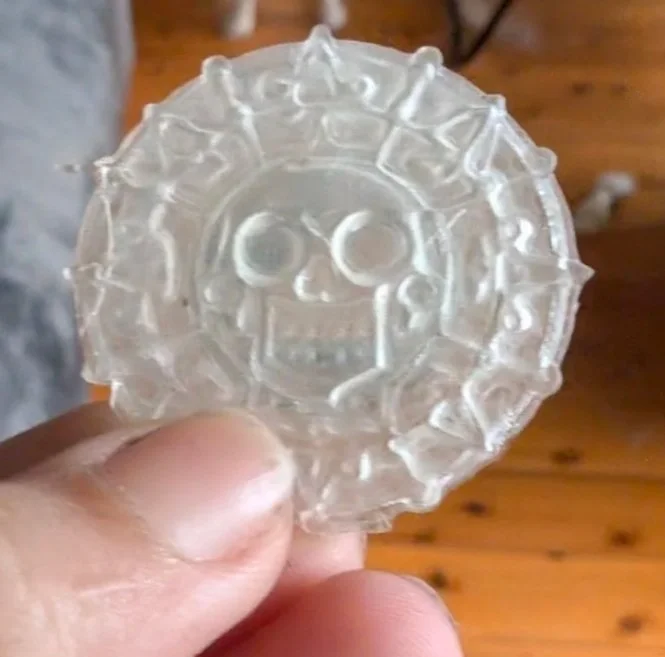
The Arcanium coin is cast in resin and hand-finished to replicate the appearance of aged bronze. The skull face replicates the film prop as closely as possible at 42mm — a diameter that sits between the two sizes of the original production pieces (38mm standard, 54mm hero close-up). The Sun Stone face carries the concentric ring structure of the Piedra del Sol.
The finish uses Vallejo bronze tones with a Vallejo Velvet Red treatment in the recesses. The Velvet Red was chosen for its semi-translucent quality — it reads as dried rather than fresh, which is the correct reference for the film's "blood price" mechanic. The coin is not supposed to look like it was just used. It is supposed to look like it has been waiting.
Embedded in the coin is an NTAG 213 NFC chip. The chip contains no personal data — only a URL. Tapping it opens the interactive exhibition, where you can rotate the 3D model, explore the hotspot annotations on each region of the coin, and read the full comparison between the Sun Stone and the film design.
The coin measures 42 × 42.2 × 3.32mm.
Why It Matters
The Sun Stone has been reproduced on Mexican currency. It appears on stamps, public monuments, and tourist merchandise. The Arcanium coin is part of a long tradition of reproduction and reinterpretation — one that began well before Hollywood and will continue long after.
What makes this piece different is that it holds both objects at once. One face is fiction. The other is history. The NFC chip is the layer that explains the relationship between them.
Most replicas are made to look like the thing they reference. This one was made to ask questions about it.
If you want to go deeper, the interactive exhibition is accessible by tapping the coin or visiting the link below. If you want to see the original, it is in Mexico City.